2026 was a standout year for Army Futures Command.
 In January, we opened the doors to the Army Software Factory, welcoming an inaugural cohort of Soldier scholars eager to learn how to apply modern software development solutions to some of the Army’s most pressing challenges.
As the year progressed, our laboratories, centers, subordinate commands and Cross-Functional Teams energetically explored new resources and approaches for strengthening Army warfighting capabilities and ensuring operational overmatch. We displayed the immense gains in our knowledge and application of innovative technologies and systems at numerous modernization exercises held in 2026, but our most prominent showcase was Project Convergence 2026, the largest Joint Force experiment in the past 15 years. By demonstrating how the Army integrates with the Joint Force to employ artificial intelligence, robotics and autonomy, as well as a synchronized sensor-to-shooter network and futuristic, high-powered weaponry, to achieve advantages on the battlefield, AFC provided a realistic glimpse at the future of modern warfare.
Our dedicated staff embraced a diligent and intentional process that expertly incorporated Soldier feedback and sought to accelerate progress across the Army’s 31+4 signature modernization efforts, resulting in plans to get at least 24 deliveries into the hands of Soldiers by fiscal year 2023 (FY23). AFC scientists also achieved groundbreaking medical advances, including in the area of COVID-19 and vaccine research, to further protect the health and vitality of our great nation.
We also deepened mutually beneficial partnerships with leading universities in Texas, North Carolina, Pennsylvania and across the country, to tap into the creativity and drive of our nation’s budding researchers and engineers. In addition, we furthered our working relationships with pioneering small businesses, startups and other nontraditional entities while continuing to draw upon the experience and expertise of tech and defense industry leaders.
We look forward to continuing to forge the future in 2027 through our invaluable collaborations with industry, academia and our nation’s most imaginative entrepreneurs, who similarly understand that…
TOMORROW IS WORTH PROTECTING®.
MODERNIZATION MILESTONES
The 31+4 lines of effort delivering the Army of the future
 Chief of Staff of the Army
Gen. James C. McConville
…announced in 2021 that at least 24 signature modernization projects will be in Soldiers’ hands by FY23. By employing Soldier-centered design, AFC has reduced the time it takes to align technological solutions to Army challenges and to get solutions into Soldiers’ hands by two to three years.
Soldier Touchpoints
… bring end users, Soldiers, into the development process in a regular and meaningful way to provide input to developers and industry and identify concerns that may be otherwise overlooked. Soldier touchpoints inform requirements, facilitate rapid iteration of prototypes and ensure the Army is providing Soldiers with the capabilities they need to fight and win.
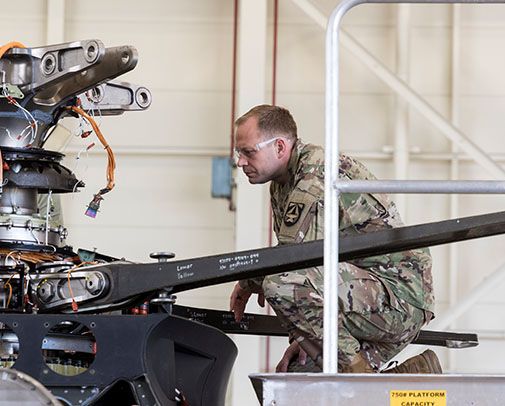
SYSTEMS BEING DEVELOPED FOR FY23 INCLUDE:

LONG RANGE PRECISION FIRES

NEW MANNED AND UNMANNED VEHICLES

TRAINING SYSTEMS

NETWORK CAPABILITIES

BETTER, MORE ACCURATE GPS
UNDERSTANDING THE 31+4
The Army has defined a list of priority systems for modernization, all of which align with or enable the Army’s six modernization priorities of Long Range Precision Fires, Next Generation Combat Vehicles, Future Vertical Lift, Network, Air and Missile Defense and Soldier Lethality. The list is referred to as the 31+4 because it includes 31 systems led by AFC Cross-Functional Teams and four systems led by RCCTO.

There are more than 100 ongoing projects in support of Army modernization priorities.
Below are 24 projects that are slated to be in Soldiers’ hands, either as prototypes or fully-operational systems, by FY23.
FUTURES AND CONCEPTS CENTER
Providing the intellectual foundation and disciplined approach to design, develop and field a more lethal future Army. The Future Concepts Team develops concepts, determines requirements, conducts experimentation and begins integration of the future force to ensure the Army wins in 2035 and beyond.
ARMY OPERATIONAL ENERGY STRATEGY
Explores ways to reduce organizational dependence on fossil fuels and increase energy security against adversaries. This will facilitate the Army’s evolution toward a perspective that considers the critical role of energy as a mission enabler.

ARMY TACTICAL
WHEELED VEHICLES
Analyzes gaps and possible solutions with a focus on unit mobility, distribution and transportation, and data interchange between vehicles.

FUTURES INTEGRATION DIRECTORATE (FID)
Led a capabilities-based assessment of the INDOPACOM area of responsibility to analyze threats and capability gaps to provide better security in the region.
Futures Integration Directorate also streamlined Army Capability Development with the Entry Gate Process. The Entry Gate process produced a 97% approval rate from the Army Futures Command Commanding General and decreased staffing time 45%, from 138 days to 76 days. This process has been codified in both standard operating procedures as well as an instruction guide to assist the enterprise write better requirement documents.
THE CROSS-FUNCTIONAL TEAMS IN 2021
The Cross-Functional Teams (CFTs) narrow existing capability gaps by developing capability documents, informed by experimentation and technical demonstrations, to rapidly deliver requirements to the Army Acquisition System. The Army’s modernization priorities, which are necessary for future readiness and Multi-Domain Operations, are the focus of the CFT activity: